Powerdown220

What Is Power Factor Correction and Why Does It Matter?

What Is Power Factor Correction and Does It Save Money?

Power factor correction is one of those terms that surfaces on energy reports, supplier quotes, and utility bills without much explanation attached. If you are a facilities manager, energy manager, or engineer at a commercial or industrial site, there is a reasonable chance you have come across it and wondered whether it is worth paying attention to. This post gives a plain-English answer to what it is, how it works, and whether it actually reduces costs.

The short version: for the right type of site, it does save money, often with a payback measured in months rather than years. But the detail matters, so here is the full picture.

What Is Power Factor Correction?

Power factor is a measure of how efficiently a site uses the electricity it draws from the grid. Specifically, it is the ratio of real power (the electricity that does actual work) to apparent power (the total electricity the grid has to supply to deliver that real power). It is expressed as a number between 0 and 1, or sometimes as a percentage.

A power factor of 1.0 means every unit of power coming in from the supply is being converted into useful output. A power factor of 0.8 means 80% is doing work and 20% is reactive power, drawn from the grid but not converted into anything productive.

Power factor correction is the process of compensating for that reactive power demand on-site, so the grid does not have to supply it. The result is a power factor closer to 1.0, a reduction in total current drawn, and in most cases a direct reduction in energy costs.

What a Poor Power Factor Is Costing You

Most commercial and industrial sites have a lagging power factor. This is caused by inductive loads: motors, compressors, pumps, HVAC systems, refrigeration equipment. These are extremely common, and they draw reactive power to generate the magnetic fields they need to operate. The more of this equipment a site runs, the further the power factor typically sits below 1.0. For a detailed explanation of the difference between lagging and leading power factor, the lagging and leading power factor guide covers that in full.

The cost shows up in two main ways. First, many UK energy suppliers add reactive power charges to commercial bills when a site draws more reactive power than an agreed threshold. These appear as kVArh line items on an energy bill and are easy to miss if you are not specifically looking for them. Second, a poor power factor means higher current flowing through cables, switchgear, and transformers to deliver the same useful output, which increases losses across the distribution system and puts more strain on equipment. The specifics of how reactive power charges work and how to read them on a bill are covered in more detail in our reactive power and kVA charges guide.

How Power Factor Correction Works

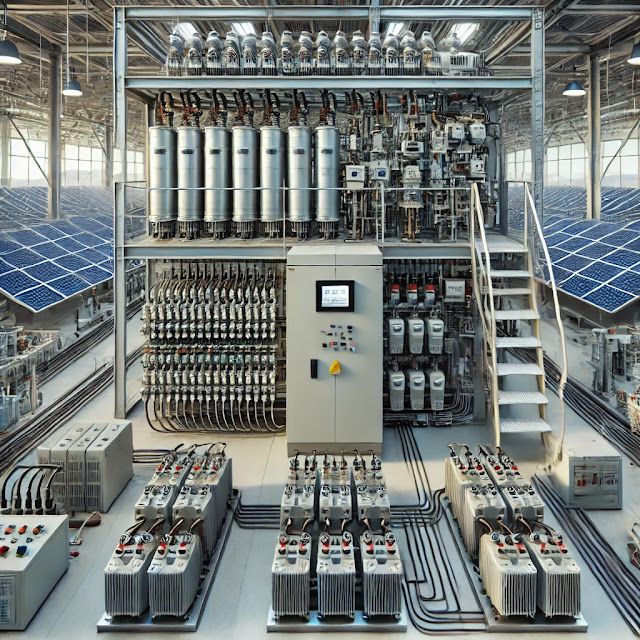
Power factor correction equipment compensates for reactive power locally, on-site, rather than drawing it from the grid. Capacitor banks (or more sophisticated active systems for variable loads) generate reactive power at the point of demand. The supply only needs to deliver the real power the site actually uses.

The practical effect is that the total current drawn from the supply drops, the power factor rises towards 1.0, and reactive power charges reduce or disappear entirely. The equipment on a site continues to operate normally: power factor correction works at the incomer level and is transparent to the connected loads. Powerdown220 designs and installs power factor correction systems for UK commercial and industrial sites, including both fixed capacitor banks and active systems for sites where the load mix changes significantly throughout the day.

Sizing matters. An undersized system will not correct the power factor sufficiently. An oversized one can push a site into leading power factor territory, which creates its own set of problems. A power factor survey before installation is what produces a system sized accurately to the site.

Does Power Factor Correction Save Money, and How Much?

Yes, for most commercial and industrial sites with inductive loads, it does. The savings come from three places.

Reactive power charges removed or reduced. If a site is currently paying kVArh charges on its energy bill, correcting the power factor eliminates or significantly reduces those charges. For sites with a poor power factor and a high energy spend, this alone can represent a meaningful annual saving.

Lower demand charges. Reducing the apparent power drawn from the grid can affect the maximum demand figure on an energy bill, which feeds into capacity charges with some tariff structures.

Reduced losses and equipment strain. Lower current across the distribution system means less heat loss in cables and less stress on switchgear and transformers. This has a secondary benefit in reduced maintenance costs and extended equipment life, though it is harder to quantify precisely.

How much the financial saving amounts to depends on the site’s current power factor, the tariff structure, and the level of reactive power being drawn. A site that is currently well within its reactive power threshold will see a different result from one that is paying substantial kVArh charges every month. Payback on power factor correction equipment is frequently measured in months rather than years, particularly where reactive power charges are significant. Any reputable supplier should be able to give you a site-specific projection based on your bills and a power quality survey, rather than a generic percentage figure.

Is Power Factor Correction Right for Your Site?

Power factor correction is a three phase commercial and industrial solution. It is not applicable to single phase domestic supplies, and it is not relevant for home energy bills. If you are reading this on behalf of a business or industrial site, read on.

The sites that see the strongest return are those with a high proportion of inductive loads: manufacturing facilities with large motor banks, logistics and warehousing with significant HVAC and materials handling equipment, hospitality and food service sites with refrigeration and ventilation, retail with refrigeration banks, and commercial offices or facilities with substantial air handling and pumping systems.

Sites where the load is primarily resistive (electric heating, for example) or LED lighting will see a smaller benefit, because those loads do not create significant reactive power demand in the first place. The voltage dependency survey will clarify this before any commitment is made.

As a general rule: if a site has significant motor, compressor, pump, or HVAC loads and has not looked at its power factor, there is a reasonable chance it is paying for reactive power it does not need to be.

How to Check Your Power Factor

There are several ways to get an initial picture without committing to a full survey.

Check your energy bill. Look for a line item labelled kVArh, reactive power, or excess reactive. If it is present and you are being charged for it, your power factor has already crossed the threshold where your supplier is billing you for it.

Ask your energy broker or supplier for half-hourly data. Many half-hourly meters log reactive power alongside real power. Reviewing a month of that data will show whether reactive demand is a consistent feature of the site’s consumption profile.

Use a power analyser at the incomer. A clip-on power analyser will give an immediate reading of power factor and reactive demand. This is useful for a quick check but does not capture how the site behaves across different operating periods.

Request a power quality survey. The most complete option. A specialist will assess the site, identify the sources of reactive demand, and produce a projection of the saving achievable from correction. Powerdown220 offers this at no charge for UK commercial and industrial sites.

If the bill check reveals kVArh charges, that is usually enough to justify requesting a survey. The charges confirm the problem exists; the survey establishes how large it is and what it would cost to fix.                         

If your energy bill includes reactive power charges, or if you have motors, compressors, or HVAC systems running across your site and have never had a power factor assessment, the free power factor survey is the logical next step. Powerdown220 has delivered power factor correction across more than 1,100 UK commercial and industrial sites. The survey is free, there is no obligation, and it will tell you clearly whether correction is worth doing and what the return looks like. Find out more about the power factor correction service or get in touch to arrange an assessment.

Power Factor Correction
Powerdown220
Privacy Overview

This website uses cookies so that we can provide you with the best user experience possible. Cookie information is stored in your browser and performs functions such as recognising you when you return to our website and helping our team to understand which sections of the website you find most interesting and useful.